

The Collected Works of
J Krishnamurti
1933 - 1967
All seventeen volumes of The Collected Works, together as one set. An extensive compendium of Krishnamurti's talks and discussions in the USA, Europe, India, New Zealand, and South Africa from 1933 to 1967.
The Collected Works have been carefully authenticated against existing transcripts and tapes. Each volume includes a frontispiece photograph of Krishnamurti , with question and subject indexes at the end.
The content of each volume is not limited to the subject of the title, but rather offers a unique view of Krishnamurti's extraordinary teachings in selected years. The Collected Works offers the reader the opportunity to explore the early writings and dialogues in their most complete and authentic form.

Glimpse of Collected Works
1933 - 1967
The Collected Works of J. Krishnamurti is a testimony to how a timeless teaching can meet boldly the challenges of changing times, of different individual and social problems, across several decades, even while retaining its quality of timelessness. Krishnamurti lived through perhaps the most tumultuous part of human history, a century that saw two world wars, the savage destruction of the earth, the breakdown of human relationships, and the overall degeneration of every aspect of human life. But his vision—that truth is a pathless land—and his mission—to set man unconditionally free—remained total and uncompromising in their refusal to step down truth for the sake of the passing moment. Questioned as to whether his teachings had changed over the decades, he was to say: ‘No. There have been changes in expression, changes in vocabulary, changes in language and gesture, but there has been no fundamental change from the beginning till now.’
In these seventeen volumes, in every page, in every paragraph of these public talks and discussions held from the year 1933 to 1967, Krishnamurti unravels the intricacies of the ‘me’ and shows how it expresses itself as the outer and the inner, as the society and the individual, as the worldly life and the spiritual life, as the fact and the ideal, as the good and the bad.
.png)
The Art of Listening
This first volume covers talks given in Italy, Norway and India. Krishnamurti begins with the statement "Friends, I should like you to make a living discovery, not a discovery induced by the description of others... I am not going to try to describe what to me is truth, for that would be an impossible attempt. One cannot describe or give to another the fullness of an experience. Each one must live it for himself."
.png)
What is Right Action?
This volume covers talks given in New Zealand, Ojai, New York, S. America and Mexico. Krishnamurti begins by stating "what we call problems are merely symptoms, which increase and multiply because we do not tackle the whole life as one but divide it as economic, social or religious problems. ..Now it is my intention to show that so long as we deal with these problems apart, separately, we but increase the misunderstanding, and therefore the conflict, and thereby the suffering and the pain..."

The Mirror of Relationship
Within the process of daily relations with people, with nature, and with society, our own causes of sorrow are revealed. 'In relationship the important thing to bear in mind is not the other but oneself,' states Krishnamurti, 'It is within oneself that harmony in relationship can be found, not in another, nor in environment.' (p. 160) This is not cause for isolation but the beginning of a process of self-revelation which creates the foundation for true relationship.

The Observer is the Observed
In these talks, given in Ojai and India, Krishnamurti discusses the nature of the observer. He states in the beginning, "to understand the confusion and misery that exist in ourselves, and to in the world, we must first find clarity within ourselves and this clarity comes about through right thinking...Right thinking comes with self knowledge. Without understanding yourself, you have no basis for thought; without self-knowledge what you think is not true."

Choiceless Awareness
In these talks in India , Krishnamurti begins by stating his intention to begin answering questions put forth to him by others. He points out that if an answer is to be right, the question itself must also be. "..a serious question put by a serious person, by an earnest person who is seeking out the solution of a very difficult problem, then, obviously, there will be an answer befitting that question."
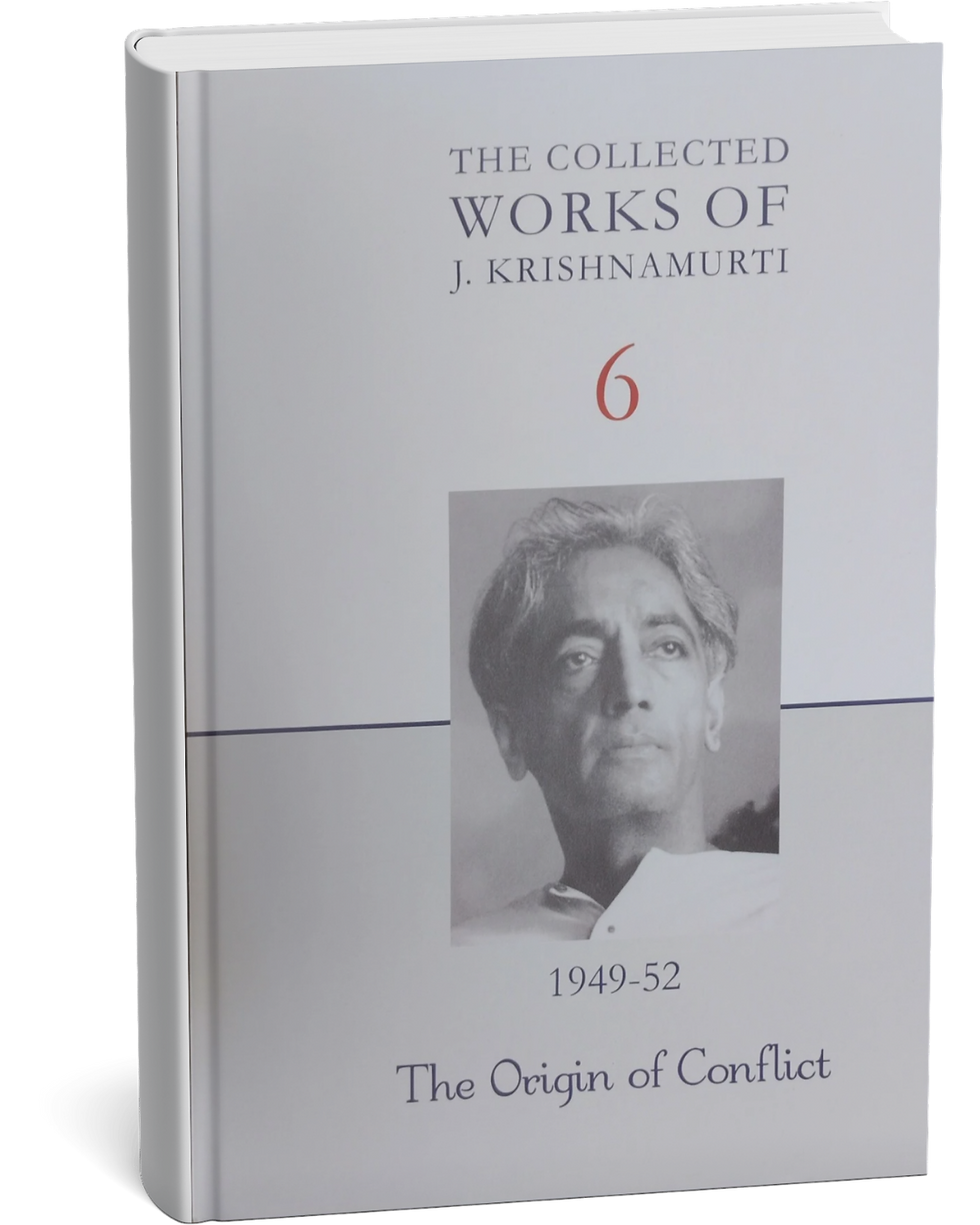
The Origin of Conflict
During this time span, Krishnamurti gave talks in England and India. In this volume, Krishnamurti introduces the material as a form of a discussion. He asks those listening to engage in the material along with him. "What I propose to do during these discussions is to think out with each one of you this extraordinarily complex problem of living. You know this problem is not confined to a narrow area. All over the world it is the same. We are confused; we do not know what to do; and we do not know how to set about it or to discover why each group is fighting the other."

Tradition and Creativity
Krishnamurti delivered these Talks at Rajghat - Banaras, on the banks of the river Ganga, during the month of December 1952, to boys and girls, of the ages of 9 to 20. Krishnamurti begins by putting forth the following questions to the students: "Why you are learning history, mathematics, geography? Have you ever thought why you go to schools and colleges? Is it not very important to find out why you are crammed with information, with so-called knowledge? What is all this so-called education? Your parents send you here because they have taken certain degrees and have passed certain examinations. Have you ever asked yourselves why you are here, and have the teachers themselves asked you why you are here? Do the teachers themselves know why they are here?"

What Are You Seeking?
The answer to the question, What are you Seeking?, is simple: We want to find truth, God, everlasting peace. The real question, says Krishnamurti, is: 'Why do you seek at all?' (p. 328) Knowing conflict, repression, self-doubt, and fear as consistent companions, we naturally wish for them to come to an end. So begins the search for relief, the search for everlasting peace--through ideas, religions, self-help, self-analysis, etc., and we think of this search as a right action towards finding what we are looking for. But do we know what we are looking for, or are we merely seeking relief from what is happening presently? Are we seeking at that point only an idea, the supposed opposite of the emotion that we are experiencing now? It is the search that maintains the present emotion and its projected opposite in a state of mutually co-existent conflict, inherently. (See January, 1954, Talks 1-15)

The Answer is in the Problem
In these Talks, given in Europe, Ojai and India, Krishnamurti addresses the need to approach our life problems in a manner does not perpetuate fragmentation. "Though we have many problems, and each problem seems to produce so many other problems, perhaps we can consider together whether the wisest thing to do is, not to seek the solution of any problem at all. It seems to me that our minds are incapable of dealing with life as a whole; we deal, apparently, with all problems fragmentarily, separately, not with an integrated outlook. Perhaps the first thing, if we have problems, is not to seek an immediate solution for them, but to have the patience to inquire deeply into them, and discover whether these problems can ever be solved by the exercise of will. What is important, I think, is to find out, not how to solve the problem, but how to approach it."

A Light to Yourself
In these talks, given in Europe and India, Krishnamurti goes into the importance of going into problems openly, without conclusions. "..because we approach our problems partially, through all these various forms of conditioning, it seems to me that we are thereby not understanding them. I feel that the approach to any problem is of much more significance than the problem itself, and that if we could approach our many difficulties without any particular form of conditioning or prejudice, then perhaps we would come to a fundamental understanding of them."

Crisis in Consciousness
In this volume, Krishnamurti takes great care to elucidate this necessity of a revolution within our consciousness where the problem lies before we expect any kind of revolutionary change outside of ourselves. Krishnamurti posits that if the politicians and scientists wanted to end starvation in the world it could be done. " It could be done, but they are not going to do it as long as their thinking is based on nationalism, on motives of their own personal profit. And even if this far-reaching outward change were brought about, it seems to me that the problem is much deeper."
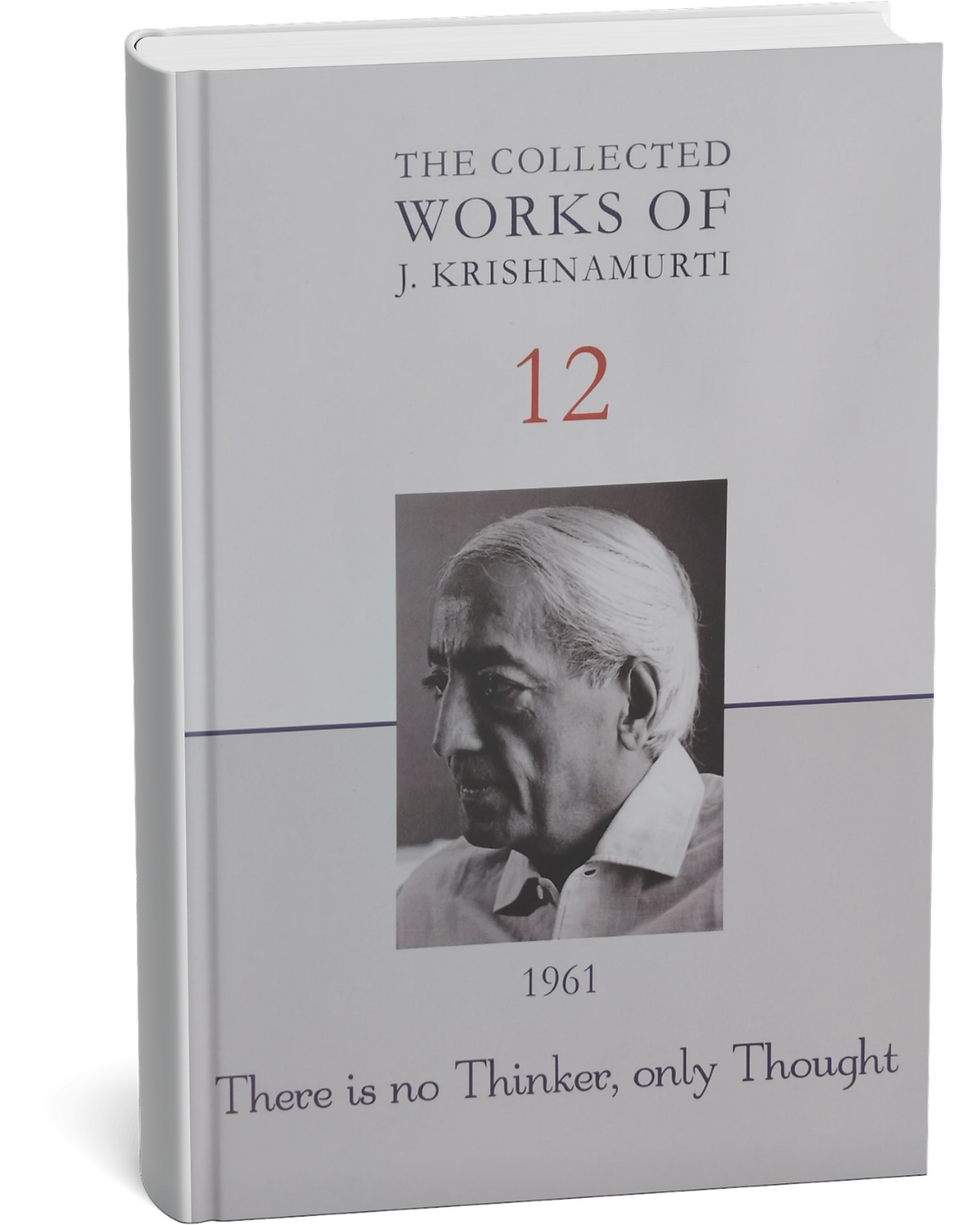
There is No Thinker, Only Thought
In these talks given in New Delhi, Bombay, London, Saanen, Paris and Madras, Krishnamurti begins by defining what he means by the word discussion and what it means to go beyond thought. "I think, before we begin, it should be made clear what we mean by discussion. To me it is a process of discovery through exposing oneself to the fact. That is, in discussing I discover myself, the habit of my thought, the way I proceed to think, my reactions, the way I reason, not only intellectually but inwardly. It is really exposing oneself not merely verbally but actually so that the discussion becomes a thing worth while - to discover for ourselves how we think. Because, I feel if we could be serious enough for an hour or a little more and really fathom and delve into ourselves as much as we can, we shall be able to release, not through any action of will, a certain sense of energy which is all the time awake, which is beyond thought."

A Psychological Revolution
The psychological revolution that Krishnamurti refers to is not only in the conscious mind, but also in the unconscious.
He states, This is one of our difficulties, perhaps our major difficulty: to be free of the whole content of the unconscious. (p. 167) This hidden part of our consciousness is the result of many thousands of years of mans endeavor; we are the sum total of his struggles, his hopes, his despairs, his everlasting search for something beyond, and this piling up of experience is still going on within us. To be aware of that conditioning, and to be free of it, demands a great deal of attention. (p. 167)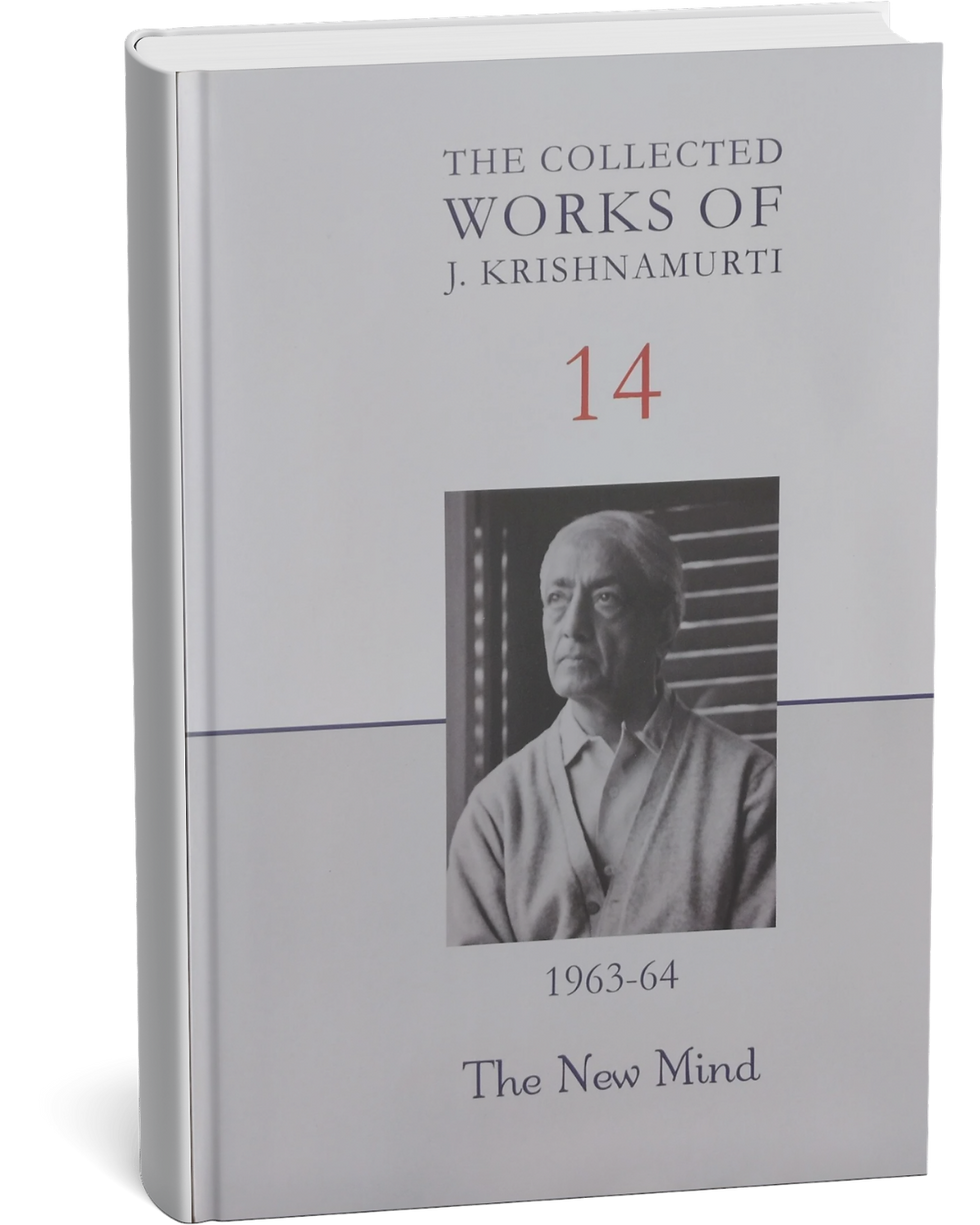
The New Mind
In these Talks, given in India and Saanen, Krishnamurti speaks to the necessity for a new way of looking, thinking and being in the world. "What is the effect or value of an individual changing? How will that transform the whole current of human existence? What can an individual do?...... there is no such thing as an individual consciousness; there is only consciousness of which we are a part. You might segregate yourself and build a wall of a particular space called the `me'. But that `me' is related to the whole, that `me' is not separate. And in transforming that particular section, that particular part, we will affect the whole of consciousness. And I think this is very important to realize: that we are not talking about individual salvation or individual reformation, but about being aware of the particular in relation to, the total. Then out of that realization comes action which will affect the whole."

The Dignity of Living
Is it possible to live without conflict? Perhaps this is a theoretical question, but it challenges the mind that is trained to accept conflict as a natural part of living. Ultimately, as Krishnamurti explains, the critical importance of that challenge is not to answer yes or no to the possibility of a life without conflict:
When you approach a problem, you start with the fact that there is conflict, and you begin to inquire whether it is possible to end it, neither accepting that it can be ended nor asserting that it cannot be ended. Your mind is then in a position to look at the fact; and that is what we must establish between us. (p. 49)
The Beauty of Death
"...only in peace that a human being can flower in goodness - not in war, not in violence, not in disorder, but only when there is a deep abiding peace. And to understand this whole phenomenon of hate, destruction and disorder, one has to enquire not merely intellectually - because such an enquiry is futile, worthless and has no meaning whatsoever - but actually what order means, what violence means, and the significance of peace; one has to enquire non-verbally, non-intellectually - [intellectual inquiry] really has very little meaning, because most of us have read or indulged in theory what peace should be, how to get rid of violence, how to establish order.." Krishnamurti gave these talks in India and Europe. The talks span the whole of human existence, exploring what it means to live rightly in a world full of confusion and misery.

Perennial Questions
"What is necessary is to examine unemotionally, not merely intellectually...the intellect doesn't solve any problem; it can only invent a lot of ideas, theories, nor can emotion dissipate the urgency of the problems that one has to face and resolve. What is necessary, it seems to me, is a mind that is capable of examination. To examine there must be freedom from personal views, with a mind that is not guided by one's own temperament, inclination, nor is compelled by circumstances.....it seems to me that one must look at them, not as an individual, but as a human being..the human being supercedes the individual...human beings have the same common factor of sorrow, of joy, of unresolved miseries, despairs, the immense loneliness of modern existence, the utter meaninglessness of life as it is lived now throughout the world;if we could consider these problems as human beings... then perhaps we can intelligently, with care, resolve our problems."